Soil Mechanics – Shear Strength of Soil
Shear Strength Parameters, Failure Criteria, Mohr's Circle and Laboratory Tests
PSC Subjective Note · Nepal Engineering Service (Civil), Second Paper · Lok Sewa Aayog
Shear Strength of Soil
Shear strength of a soil is the resistance offered by soil grains against shear failure of the soil mass.
Shear Strength Depends Upon
- The normal stress applied on the soil mass.
- The angle of internal friction of the soil mass.
- The cohesion or adhesion bond of the soil mass.
- The drainage condition of the soil mass.
- The past stress history of the soil mass (NC, OC, UC).
Importance: Shear strength is the important property which is essential in problems of bearing capacity of foundations, design of retaining structures, design of pavements and stability analysis of slopes.
Shear Strength Parameters
The shear strength is due to the following parameters:
- Cohesion of soil (c)
- Angle of internal friction / shearing resistance (φ)
| Type of soil | Condition | Shear strength | Example |
|---|---|---|---|
| Pure cohesive soil | φ = 0 | Entirely due to c | Clay |
| Cohesionless soil | c = 0 | Entirely due to φ | Sand |
| c–φ soil | c ≠ 0 and φ ≠ 0 | Due to both c and φ | Silt |
Hence, the shear strength parameters of soil are c and φ.
Failure Criteria
General statement: A soil mass fails in shear when the shear strength of the soil is less than the stress coming from super-structures.
1. Mohr's Failure Criteria
- According to Mohr, the shear strength of soil is a function of normal stress: τ = f(σ).
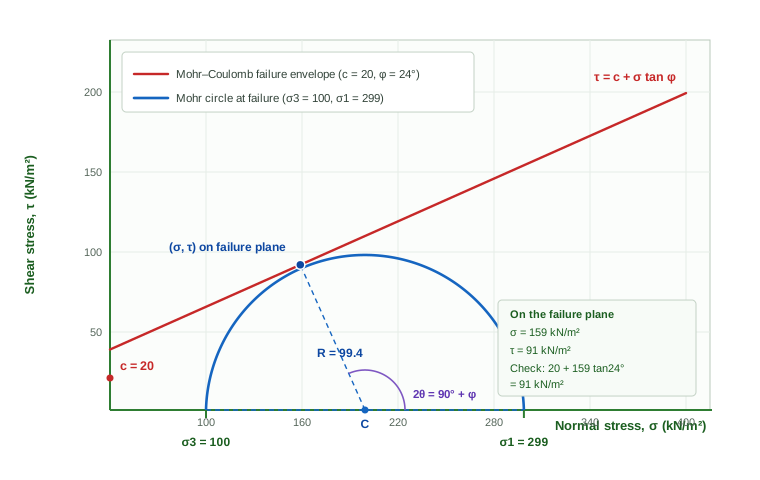
- Normal stress is plotted along the X-axis, whereas shear stress is plotted along the Y-axis, in such a way that the failure envelope is tangential to the Mohr circle.
2. Coulomb's Failure Criteria
According to Coulomb, the shear strength of soil is given by:
Where c = cohesion of soil, φ = angle of internal friction, σ = total stress.
3. Mohr–Coulomb's Failure Criteria
- It is a combination of the Mohr and Coulomb criteria.
- The Mohr circle is drawn for the stresses at failure and the straight-line Coulomb envelope is made tangential to it.
4. Modified Mohr–Coulomb's Failure Criteria
- The shear strength is expressed in terms of effective stress.
Where σ′ is the effective stress (= σ − u), and c′, φ′ are the effective stress parameters.
Remember: The general Mohr–Coulomb equation written with total stress uses c and φ; written with effective stress it uses c′ and φ′. For a saturated soil, the effective stress form is the one that controls shear strength.
Principal Stresses in Soil
- A soil mass is subjected to two types of stresses: normal stress (σ) and shear or tangential stress (τ).
- The maximum and minimum values of normal stress are known as principal stresses, and the plane containing them is known as the principal plane.
| Principal stress | Symbol | Remarks |
|---|---|---|
| Major principal stress | σ1 | Maximum normal stress |
| Minor principal stress | σ3 | Minimum normal stress |
| Intermediate principal stress | σ2 | Generally neglected in soil mechanics |
Mohr's Circle
Procedure
- Plot OA = σ3 and OB = σ1 along the X-axis.
- Distance AB = σ1 − σ3. Bisect AB at point C such that BC = CA = (σ1 − σ3)/2 = radius of the circle.
- Taking C as centre and BC or CA as radius, draw a circle; this is known as Mohr's circle.
- With reference to the line OX, measure angle 2θ in the anticlockwise direction at point C to locate point P on the circle.
- The coordinates of P give the values of σ and τ on the inclined plane.
Uses
- Graphical representation of the major and minor principal stresses (σ1 and σ3).
- Used to determine the normal and tangential stresses on an inclined plane.
- Used with the failure envelope to identify the failure plane and the shear strength at failure.
Obliquity Equation
From the geometry of Mohr's circle at failure, where the circle is tangential to the envelope τ = c + σ tanφ:
Important Forms
Angle of the failure plane: The failure plane is inclined at θ = 45° + φ/2 with the major principal plane (i.e. with the horizontal in a triaxial compression test). This is also called the angle of obliquity.
Hence, if the failure plane makes an angle α with the horizontal in an unconfined compression test, then φ = 2α − 90°.
| Symbol | Meaning |
|---|---|
| σ1 | Major principal stress at failure (cell pressure + deviator stress) |
| σ3 | Minor principal stress at failure (cell / confining pressure) |
| σc | Cell pressure, confining pressure or all-round pressure |
| σd | Deviator, additional or extra stress |
| Nφ | Flow value = tan2(45° + φ/2) |
Solved Examples
Example 1: Shear strength on a horizontal plane (effective stress)
An embankment is planned to be constructed from a soil with c = 4 kg/cm2 and φ = 26°. Evaluate the shear strength of the material on a horizontal plane at a point 10 m below the surface of the embankment. The bulk density of the soil is 2.3 g/cm3 and the pore water pressure at that point is 1.8 kg/cm2.
Solution:
Total vertical stress at 10 m depth,
Pore water pressure, u = 1.8 kg/cm2. Hence effective stress,
Shear strength by the modified (effective stress) Mohr–Coulomb criterion, with tan 26° = 0.4877:
Answer: τ ≈ 4.24 kg/cm2 (about 416 kN/m2).
Note: Using total stress instead of effective stress would give τ = 4 + (2.3 × 0.4877) = 5.12 kg/cm2, which is not correct for a saturated soil because it ignores pore water pressure. Answers quoted in some note sets (for example 7.06 kg/cm2) arise from inconsistent unit conversion; the effective stress calculation above is the standard method. Always convert kg/cm2 to kN/m2 by multiplying by 98.1.
Example 2: Cohesion and angle of internal friction from an unconfined test
A cylinder of soil fails under an axial vertical stress of 100 kN/m2 when it is laterally unconfined. The failure plane makes an angle of 50° with the horizontal. Calculate the value of cohesion and the angle of internal friction of the soil.
Solution:
In an unconfined compression test, σ3 = 0 and σ1 = 100 kN/m2. The failure plane makes α = 50° with the horizontal (= major principal plane), so:
Now sinφ = (σ1 − σ3) / (σ1 + σ3 + 2c cotφ):
Answer: φ = 10° and c ≈ 42 kN/m2.
Example 3: Deviator stress at failure in a dry cohesionless triaxial test
A sample of dry cohesionless soil was tested in a triaxial machine. If the angle of shearing resistance was 36° and the confining pressure was 100 kN/m2, determine the deviator stress at which the sample failed.
Solution:
For cohesionless soil, c = 0, so σ1 = σ3 Nφ. With φ = 36°:
Answer: the deviator stress at failure is about 285 kN/m2.
Example 4: Shear strength parameters from two UU triaxial test results
The following results were obtained in an undrained triaxial test on a soil. Determine the shear strength parameters.
| Confining pressure, σ3 (kg/cm2) | Deviator stress at failure, σd (kg/cm2) |
|---|---|
| 2 | 5 |
| 5 | 9 |
Solution:
For test 1: σ1 = 2 + 5 = 7 kg/cm2, σ3 = 2 kg/cm2.
For test 2: σ1 = 5 + 9 = 14 kg/cm2, σ3 = 5 kg/cm2.
Using σ1 = σ3 Nφ + 2c √Nφ, and writing x = √Nφ:
Subtracting (i) from (ii): 7 = 3x2 ⇒ x2 = 2.333 ⇒ x = 1.5275
From (i): 2c × 1.5275 = 7 − 2(2.333) = 2.334 ⇒ c = 0.764 kg/cm2
Check with (ii): 5(2.333) + 2(0.764)(1.5275) = 11.67 + 2.33 = 14.0 ✓
Answer: c ≈ 0.76 kg/cm2 (about 75 kN/m2) and φ ≈ 23.6°.
Laboratory Test for Determination of Shear Strength Parameters
- Direct shear test
- Triaxial test
- Consolidated Drained Test (CD test)
- Unconsolidated Undrained Test (UU test)
- Consolidated Undrained Test (CU test)
- Unconfined compression test
- Vane shear test
Direct Shear Test
- The main objective of this test is to determine the shear strength parameters (c and φ) of the soil.
- Mainly used for coarse-grained soil.
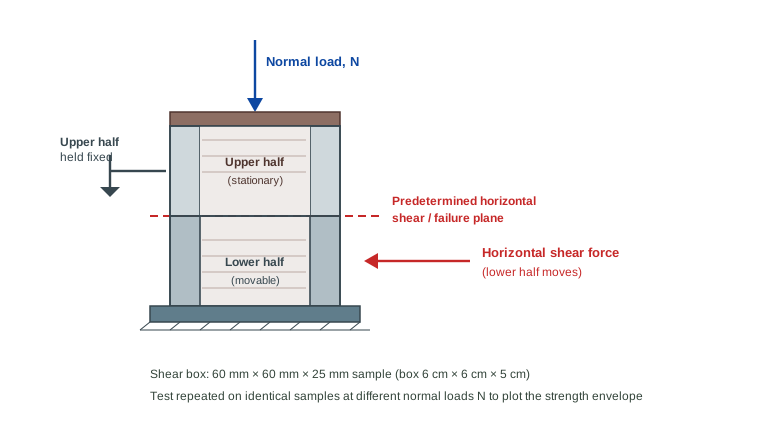
- Conducted in a box known as a shear box (upper part is stationary, whereas the lower part is movable). Typical dimension 6 cm × 6 cm × 5 cm.
- A soil sample of size 60 mm × 60 mm × 25 mm is placed between the two halves of the shear box.
- At the top of the soil sample, a normal pressure is applied and is kept constant for one test specimen.
Procedure
- A horizontal force is applied on the lower half of the box, and the upper half is restrained against movement.
- The horizontal force on the lower half of the box is applied such that the bottom box starts sliding relative to the top box. The load is applied till the soil sample gets sheared off.
- Similarly, a number of test results are obtained by changing the sample specimen and applying a number of normal loads.
- A graph is plotted between normal stress and the corresponding shear stress; the graph so plotted is known as the strength envelope.
- The intercept made by the graph with the Y-axis is the cohesion of soil (c).
- The inclination of the strength envelope with the horizontal is the angle of internal friction (φ) or angle of shearing resistance.
Advantages of Direct Shear Test
- Quick test.
- Simple and economic.
- Suitable for sandy soil having high permeability.
- Since the thickness of the sample is very less, perfect drainage can be achieved.
Disadvantages of Direct Shear Test
- No control on drainage.
- Inner pore water pressure cannot be measured.
- The failure plane is predetermined, i.e. horizontal, but in the real field this may not necessarily be the weakest plane on which the failure occurs.
Triaxial Test
- The main objective of this test is to determine the shear strength parameters (c and φ) of a soil.
- A cylindrical soil sample with length 2.5 times its diameter is taken (typical diameter 38 mm or 50 mm).
- In this method, the major principal stress (σ1) acts in the vertical direction whereas the minor principal stress (σ3) acts in the horizontal direction.
Stages of the Test
- Consolidation stage: The cell pressure (σc) is applied in all directions, and σc is measured with the help of a dial gauge.
- Shearing stage: An additional stress (σd) is applied in the vertical direction with the help of a plunger. σd is also measured with the help of a dial gauge.
Relationship between Principal Stresses
- Cell / confining / all-round pressure = σ3 = σc
- Deviator / additional / extra stress = σd = σ1 − σ3
Triaxial Cell
- The triaxial cell consists of a circular base on which a central pedestal is mounted.
- A water valve is connected with the pedestal for pore water pressure measurement and also for drainage.
- The middle part of the cell is a pressure chamber.
- A loading ram passes through the centre of the upper cap to provide axial load (deviator stress) on the sample.
- A soil specimen is kept inside the triaxial cell with a porous plate at the top and bottom.
- The loading cap is placed on top of the pedestal.
- The specimen is enclosed in a rubber membrane to prevent its contact with the cell fluid.
- The cylindrical specimen is kept under stress: it is subjected to confining pressure initially and then to additional stress known as deviator stress. The test is continued till the sample fails.
Types of Triaxial Test (on the Basis of Drainage Condition)
| Test | Consolidation stage | Shearing stage | Other name |
|---|---|---|---|
| Consolidated Drained (CD) | Drainage allowed; sample is consolidated under confining pressure | Drained loading condition | Slow test (S-test) |
| Consolidated Undrained (CU) | Drainage permitted until consolidation is completed | Undrained loading condition | R-test |
| Unconsolidated Undrained (UU) | Drainage not allowed during application of confining pressure | Undrained loading condition | Quick test (Q-test) |
In the CD test drainage is allowed in both stages; in the CU test drainage is allowed only during consolidation; in the UU test drainage is not allowed in either stage.
Advantages of Triaxial Test
- Most accurate test.
- Pore water pressure changes and volumetric changes can be measured directly.
- The state of stress at all intermediate stages up to failure is known, and the Mohr circle can be drawn at any stage of shear.
- The failure plane is not pre-determined, i.e. the soil can fail on any plane.
Disadvantages of Triaxial Test
- The apparatus is costly and bulky.
- The consolidation of the specimen in the test is isotropic, whereas in the field the consolidation is generally anisotropic.
- It is not possible to determine the cross-sectional area of the specimen accurately at large strain, as the assumption that the specimen remains cylindrical does not hold good.
- The drained test takes a longer period as compared to that in a direct shear test.
Unconfined Compression Test on Saturated Clay
The relationship between σ1 and σ3 is given by:
It is a modification of the triaxial test with the confining cell pressure equal to zero, because the soil sample is not subjected to any confining pressure, i.e. σ3 = 0. The sample can be placed directly on a compression testing machine without the need of a triaxial cell.
For purely cohesive soil, i.e. clay, φ = 0, so Nφ = tan245° = 1 and:
where qu is the unconfined compressive strength and cu is the undrained shear strength of the soil:
Unconfined Compressive Strength
- The maximum compressive stress that a soil sample can resist is known as the unconfined compression strength (qu).
where F is the axial compressive force at failure and Ac is the corrected cross-sectional area of the soil sample at failure.
where A0 is the original cross-sectional area, ΔL is the change in length and L0 is the original length.
Sensitivity of Soil
The unconfined compression test is used to determine the sensitivity of soil.
| Sensitivity, St | Nature of soil |
|---|---|
| 1 (approximately) | Insensitive |
| 1 to 2 | Low sensitivity |
| 2 to 4 | Medium sensitivity |
| 4 to 8 | Sensitive |
| > 8 | Quick / extra sensitive |
Advantages of Unconfined Compression Test
- The test is convenient, simple and quick.
- Ideally suited for measuring the unconsolidated–undrained shear strength of intact, saturated clays.
- The sensitivity of the soil may be easily determined by conducting the test on an undisturbed sample and then on the remoulded sample.
Disadvantages of Unconfined Compression Test
- The test cannot be conducted on fissured clays.
- The test may be misleading for soils for which the angle of shearing resistance is not zero; for such soils, the shear strength is not equal to half the compressive strength.
Vane Shear Test
- Used to determine the undrained shear strength (cu) of soft, sensitive clays in the field or laboratory, where sampling and the unconfined compression test are difficult.
- A four-bladed vane is pushed into the soil and rotated at a uniform rate; the torque required to shear the soil in a cylindrical surface is measured.
- The vane is rotated until failure, and the undrained shear strength is obtained from the failure torque T for a vane of diameter D and height H:
where T is the torque at failure, D is the overall vane diameter and H is the height of the vane (both ends of the vane shearing). If only one end shears, the end term becomes πD3/12.
The vane shear test gives only the undrained shear strength (cu); φ is not obtained. It is most useful for soft, sensitive clays and can be performed in the field or in the laboratory.
Summary
Key Points to Remember
- Shear strength is the resistance offered by soil grains against shear failure; the parameters are c and φ.
- τ = c + σ tanφ (Mohr–Coulomb); in effective stress form τ = c′ + σ′ tanφ′.
- Pure cohesive soil: φ = 0 (clay). Cohesionless soil: c = 0 (sand). c–φ soil: both (silt).
- Mohr's circle is drawn with σ on the X-axis and τ on the Y-axis; the failure envelope is tangential to it.
- At failure: σ1 = σ3Nφ + 2c√Nφ, with Nφ = tan2(45° + φ/2).
- The failure plane is inclined at 45° + φ/2 with the major principal plane.
- Direct shear: quick and simple, predetermined horizontal failure plane, no control on drainage.
- Triaxial: most accurate, measures pore pressure, no predetermined failure plane; CD (slow), CU (R), UU (quick) based on drainage.
- Unconfined compression: σ3 = 0, cu = qu/2 for φ = 0; used for sensitivity of clays.
- Vane shear: undrained shear strength of soft clays, from failure torque.
For Exams:
- Always write the failure envelope equation before drawing Mohr's circle.
- State clearly whether c, φ are total stress or effective stress parameters.
- For numericals, convert units to kN/m2 (1 kg/cm2 ≈ 98.1 kN/m2) before answering.
- Draw the triaxial cell or shear box neatly with labels; one diagram earns marks quickly.
Long / Descriptive Questions and Answers
Define Shear Strength of Soil and State the Factors on Which It Depends (5)
Shear strength of a soil is the resistance offered by soil grains against shear failure of the soil mass. It is the important property essential in problems of bearing capacity of foundations, design of retaining structures, design of pavements and stability analysis of slopes.
It depends upon:
- The normal stress applied on the soil mass.
- The angle of internal friction of the soil mass.
- The cohesion or adhesion bond of the soil mass.
- The drainage condition of the soil mass.
- The past stress history of the soil mass (NC, OC, UC).
Explain the Failure Criteria of Soil (5) or (10)
- General: a soil mass fails in shear when the shear strength of the soil is less than the stress coming from super-structures.
- Mohr's criteria: the shear strength of soil is a function of normal stress, τ = f(σ); normal stress is plotted on the X-axis and shear stress on the Y-axis such that the failure envelope is tangential to the Mohr circle.
- Coulomb's criteria: τ = c + σ tanφ, where c is cohesion, φ is the angle of internal friction and σ is the total stress.
- Mohr–Coulomb criteria: a combination of Mohr and Coulomb criteria, τ = c + σ tanφ, with a straight-line envelope tangential to the failure Mohr circle.
- Modified Mohr–Coulomb criteria: the shear strength is written in terms of effective stress, τ = c′ + σ′ tanφ′.
Explain Mohr's Circle with Its Procedure and Uses (5)
Mohr's circle is the graphical representation of the major and minor principal stresses, used to determine normal and tangential stresses on an inclined plane.
- Plot OA = σ3 and OB = σ1 along the X-axis.
- AB = σ1 − σ3; bisect AB at C so that BC = CA = (σ1 − σ3)/2 = radius.
- With centre C and radius BC, draw the circle known as Mohr's circle.
- Measure 2θ anticlockwise from OX at C to locate point P; the coordinates of P give σ and τ on the inclined plane.
Uses: representation of σ1 and σ3, determination of stresses on an inclined plane, and location of the failure plane when the failure envelope is tangential to the circle.
Describe the Direct Shear Test with Advantages and Disadvantages (5) or (10)
The direct shear test determines the shear strength parameters c and φ of soil, mainly coarse-grained soil. The soil sample (60 × 60 × 25 mm) is placed between the two halves of a shear box (6 × 6 × 5 cm); the upper half is stationary and the lower half is movable. A constant normal pressure is applied on top, and a horizontal force is applied to the lower half until the sample is sheared. The test is repeated on fresh specimens at different normal loads, and shear stress is plotted against normal stress. The intercept on the τ axis gives c and the slope of the strength envelope gives φ.
Advantages: quick, simple and economic; suitable for sandy soil of high permeability; perfect drainage can be achieved because the sample thickness is small.
Disadvantages: no control on drainage; inner pore water pressure cannot be measured; the failure plane is predetermined (horizontal) and may not be the weakest plane in the field.
Describe the Triaxial Test and Its Types (10)
A cylindrical sample with length 2.5 times its diameter is enclosed in a rubber membrane inside a triaxial cell, with porous plates and drainage connections at the top and bottom. The major principal stress acts vertically and the minor principal stress acts horizontally. The test has two stages: (i) consolidation, in which cell pressure σc is applied all round, and (ii) shearing, in which an additional vertical deviator stress σd is applied through the loading ram until failure. At failure σ1 = σ3Nφ + 2c√Nφ, with Nφ = tan2(45° + φ/2). Mohr circles are drawn for several confining pressures and the common tangent gives c and φ.
- CD test: drainage allowed in both stages; also called the slow test (S-test).
- CU test: drainage permitted until consolidation is complete, then sheared undrained; also called the R-test.
- UU test: no drainage in either stage; also called the quick test (Q-test).
Explain the Unconfined Compression Test and Sensitivity of Soil (5) or (10)
It is a modification of the triaxial test with the confining pressure equal to zero (σ3 = 0), so the sample can be placed directly on a compression testing machine without a triaxial cell. Since σ1 = 2c√Nφ, and for purely cohesive soil φ = 0 gives Nφ = 1, we get σ1 = 2c, so the undrained shear strength is cu = qu/2, where qu = F/Ac is the unconfined compressive strength and Ac = A0/(1 − ε) is the corrected area at failure.
Sensitivity is the ratio of the unconfined compressive strength of the undisturbed soil to that of the remoulded soil, St = qu(undisturbed)/qu(remoulded). Soils with St near 1 are insensitive; values of 2–4 indicate medium sensitivity, 4–8 sensitive, and above 8 quick or extra sensitive.
Compare Direct Shear Test and Triaxial Test (5)
| Basis | Direct shear test | Triaxial test |
|---|---|---|
| Failure plane | Predetermined (horizontal) | Not predetermined; soil can fail on any plane |
| Drainage control | No control | Full control; CD, CU and UU possible |
| Pore water pressure | Cannot be measured | Can be measured directly |
| Stress state | Only at failure is known | Known at all intermediate stages |
| Accuracy and cost | Simple, quick, economic | Most accurate but costly and bulky |
| Suitable soil | Coarse-grained / sandy soil | All soils, both drained and undrained conditions |
Related note: For compaction, OMC, Proctor tests and field compaction control, read Soil Mechanics – Soil Compaction.